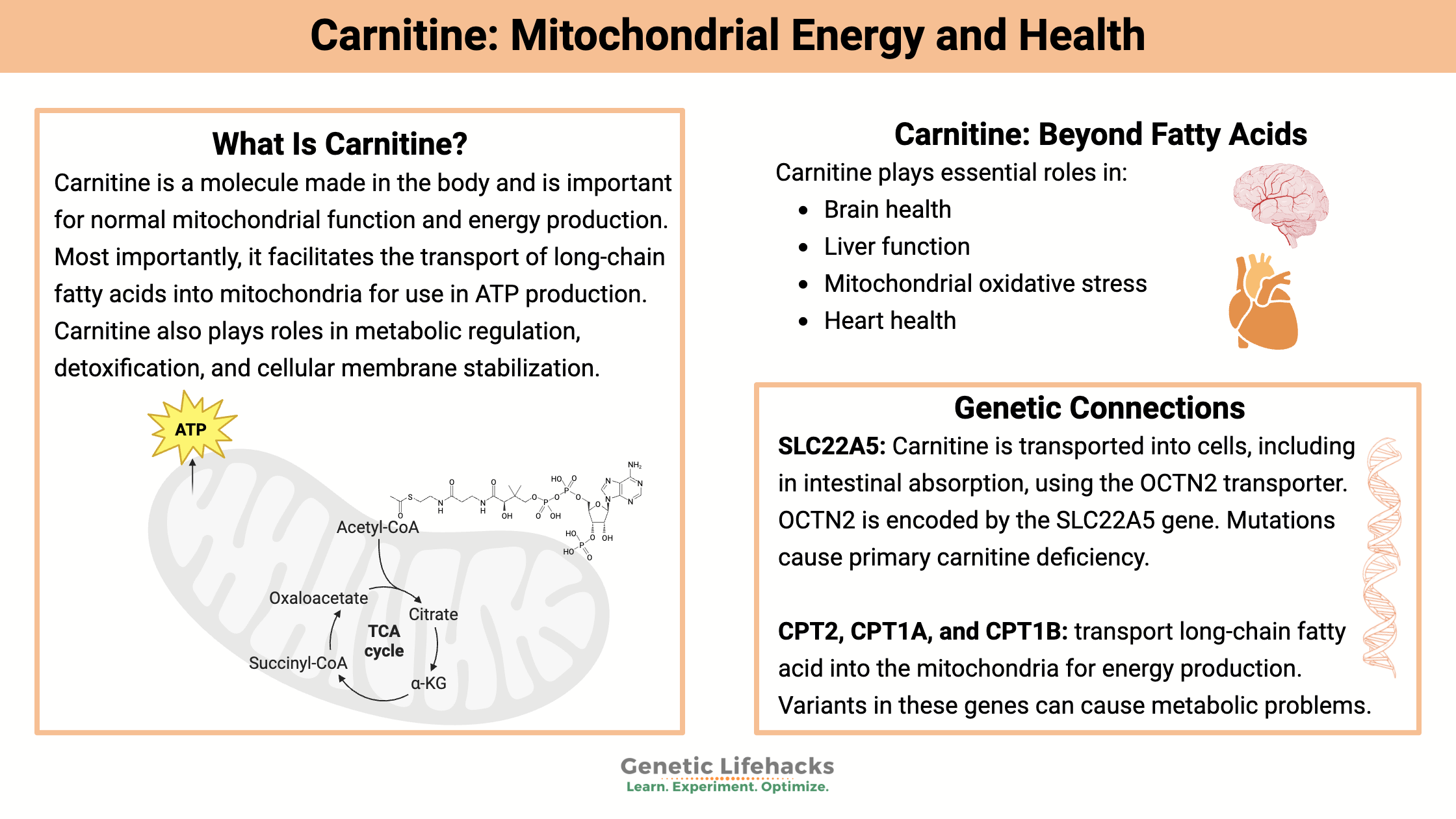
Description L-Carnitine is a very small molecule that enables free fatty acids to be transported into the mitochondria of cells to turn into energy
Mercadal, L., Coudert, M., Vassault, A., Pieroni, L., Debure, A., Ouziala, M., Depreneuf, H., Fumeron, C., Servais, A., Bassilios, N., Becart, J., Assogba, U., Allouache, M., Bouali, B., Luong, N., Dousseaux, M

Structure MOL SDF PDB SMILES InChI View Structure Structure for L-carnitine (PAMDB110763) Synonyms: -trimethyl-hydroxybutyrobetaine 3-hydroxy-4-trimethylammoniobutanoate R-(-)-3-hydroxy-4-trimethylaminobutyrate vitamin B T bicarnesine ( R )-carnitine -L-trimethyl--hydroxybutyrobetaine vitamin Bt 3-carboxy-2-hydroxy-N,N,N-trimethyl-1-propanaminium Chemical Formula: C 7 H 15 NO 3 Average Molecular Weight: 161.2 Monoisotopic Molecular Weight: 162.1130183851 InChI Key: PHIQHXFUZVPYII-ZCFIWIBFSA-N InChI: InChI=1S/C7H15NO3/c1-8(2,3)5-6(9)4-7(10)11/h6,9H,4-5H2,1-3H3/t6-/m1/s1 CAS number: Not Available IUPAC Name: (3 R )-3-hydroxy-4-(trimethylammonio)butanoate Traditional IUPAC Name: Not Available SMILES: C(C(O)CC(=O)[O-])[N+](C)(C)C Chemical Taxonomy Taxonomy Description This compound belongs to the class of organic compounds known as carnitines
supplemental doses usually range from 0.5 to 2 g/day
Herzmann C, Johnson MA, Youle M
L-carnitine is known to boost mitochondrial function and lessen decay